

6th AUN-TEPL Symposium
3rd - 4th Jun 2026
Universiti Brunei Darussalam,
Bandar Seri Begawan, Brunei
As Chair of the AUN-TEPL Thematic Network, SMU convened educators and policymakers from across ASEAN+3 to advance ethical and inclusive AI adoption.
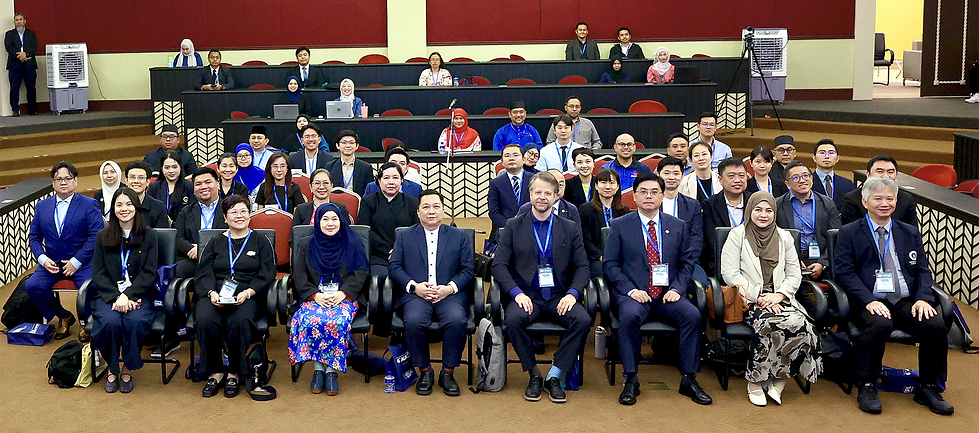
More than 60 educators, academic leaders and policymakers from across the ASEAN+3 region convened in Brunei on 3 and 4 June 2026 for the 6th ASEAN University Network Thematic Network on Technology-Enhanced Personalised Learning (AUN-TEPL) Symposium hosted by Universiti Brunei Darussalam (UBD).
More than 60 educators, academic leaders and policymakers from across the ASEAN+3 region convened in Brunei on 3 and 4 June 2026 to examine one of higher education's most pressing challenges: how to harness artificial intelligence (AI) to personalise learning without compromising ethics, fairness and academic integrity. Themed "Ethics in Personalised Learning", the 6th ASEAN University Network Thematic Network on Technology-Enhanced Personalised Learning (AUN-TEPL) Symposium was hosted by Universiti Brunei Darussalam (UBD) and chaired by Singapore Management University (SMU).
Discussions focused on the opportunities and risks presented by AI and emerging technologies, and how universities can deploy them responsibly to build more inclusive, responsive and learner-centred learning environments. The symposium was jointly organised by UBD together with AUN-TEPL co-lead institutions Mahidol University (MU), Universiti Malaya (UM) and the University of the Philippines Diliman (UPD).
Throughout the two-day symposium, participants exchanged ideas and best practices on the opportunities and challenges of AI-enabled education. The conversations highlighted the importance of balancing technological innovation with ethical considerations to ensure that learning remains equitable, human-centred and aligned with educational goals.

“As AI continues to reshape teaching, learning and student engagement, it is important to ensure that technological advancement is guided by ethics, inclusivity and human values, while strengthening regional partnerships to support responsible innovation in education,” said Professor Noor Azam, Deputy Vice Chancellor of Universiti Brunei Darussalam in his welcome address. He was highlighting AUN-TEPL's evolution into a strong regional platform for collaboration, innovation and knowledge exchange, and its role in bringing institutions together to address emerging opportunities and challenges in higher education.
Professor Noor Azam, Deputy Vice Chancellor of Universiti Brunei Darussalam, underscored the role of ASEAN universities in advancing ethical and human-centred approaches to AI-enabled education during his opening address.
Associate Professor Tamas Makany underscored the importance of human-centred AI learning and regional collaboration in developing ethical, inclusive and future-ready education across ASEAN+3.
Underscoring the importance for human-centred AI learning and design, Associate Professor Tamas Makany, Chairman of the AUN-TEPL Thematic Network urged institutions to adopt ethical, learner-focused approaches to AI integration.
Speaking on the importance of regional collaboration in strengthening educator capabilities, sharing standards and resources, and advancing collaborative research on AI in education across ASEAN, Associate Professor Makany announced the network's plans to evolve into the ASEAN University Network for Artificial Intelligence in Education (AUN-AIE) in the coming months. This initiative reflected the network’s growing regional focus on AI-enabled teaching, learning and research, and a commitment towards supporting higher education institutions in navigating the opportunities and challenges presented by rapidly evolving AI technologies.


Associate Professor Dr Thanapan Laiprakobsup, Executive Director of the ASEAN University Network (AUN), highlighted the transformative role of technology in creating more inclusive and flexible learning environments. Reflecting on the rapid advancement of AI, he emphasised the importance of ensuring that innovation remains grounded in ethical principles.
Keynote Presentation
AI Ethics in Personalised Learning: A Case for Experiential Learning as the Ethical Response to Generative AI
Dr Jeremy Van Hof, Director of the Center for Teaching and Learning Innovation at Michigan State University, delivered the keynote address, “AI Ethics in Personalised Learning: A Case for Experiential Learning as the Ethical Response to Generative AI”. He emphasised the deliberate and intentional use of AI to make learning processes more visible, enabling educators to gain deeper insights into how students learn, think and develop over time. “While AI may increasingly support learning through content generation and personalised scaffolding, educators remain essential in guiding students, responding to their needs and designing meaningful experiential learning opportunities that foster critical thinking, growth and engagement,” commented Dr Van Hof, underscoring the indispensable role of educators in an AI-enabled future.

Panel Presentation
Balancing Innovation and Integrity: Navigating Ethical Dilemmas in Technology-Enhanced Personalised Learning
Building on the keynote themes, a panel from AUN-TEPL co-lead universities, including Associate Professor Ouh Eng Lieh from Singapore Management University's School of Computing and Information Systems, examined how higher education institutions can navigate ethical challenges while advancing AI-enabled education. The discussion focused on governance, AI literacy and responsible implementation, underscoring the importance of frameworks that enable innovation while upholding academic integrity and educational values. The symposium featured a series of hands-on workshops that explored practical applications of technology-enhanced learning. Participants explored topics such as integrating Canva and AI into digital pedagogy, creating interactive digital learning resources with AI, developing higher education AI policies that balance innovation with academic integrity, ethics and security, and best practices in credit transfer for standalone online courses across ASEAN.

A panel comprising representatives from AUN-TEPL co-lead universities including Associate Professor Ouh Eng Lieh from School of Computing and Information Systems, SMU shared insights on how higher education institutions can balance innovation and ethics in advancing AI-enabled education.

Dr. Jetsada Arnin
Assistant to the President for Education,
Mahidol University

Prof. Sun Hua
Professor,
Peking University

Dr. Tipajin Thaipisutikul
Assistant Professor,
Mahidol University

Dr. Nur Akmarina Mohd Said
Senior Lecturer,
Universiti Malaya

Assoc. Prof. Ouh Eng Lieh
Associate Professor,
Singapore Management University

Assoc. Prof. Miguel Francisco M. Remolona
Associate Professor,
University of the Philippines Diliman
Concurrent Workshops
The symposium featured a series of hands-on workshops that explored practical applications of technology-enhanced learning. Participants explored topics such as integrating Canva and AI into digital pedagogy, creating interactive digital learning resources with AI, developing higher education AI policies that balance innovation with academic integrity, ethics and security, and best practices in credit transfer for standalone online courses across ASEAN.

Isaac Koh (left) and Shamie Jegan (right) from SMU Centre for Teaching Excellence shared practical strategies on harnessing AI to support effective pedagogy, learner engagement and personalised learning experiences.
A fireside chat on the second day of the symposium examined how universities might harness AI to enhance learning while fostering creativity, critical thinking and responsible technology use. Titled "Ethical AI and Transformative Learning: Empowering Educators, Inspiring Student Innovation", the session highlighted the potential of ethical generative AI, Challenge-Based Project Learning and innovative digital pedagogies to empower educators and cultivate future-ready graduates. The symposium reaffirmed AUN-TEPL's commitment to advancing innovative, ethical and learner-centred approaches to higher education across ASEAN+3.